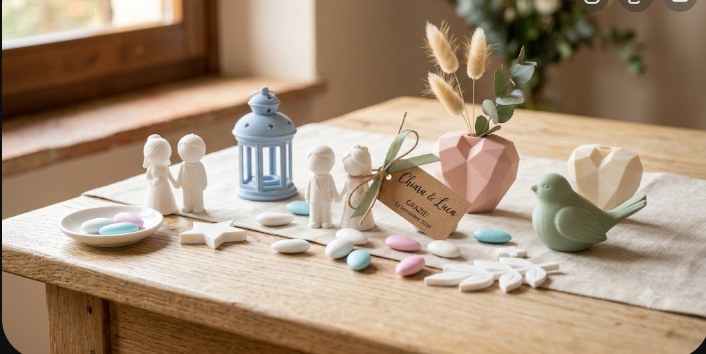
Each of us has that drawer. The one that barely opens because it’s full of little bags of sugared almonds, plaster figurines with no reason to exist and keyrings from weddings we can’t recall. Party favours, historically, have a survival rate comparable to a succulent left in my care: good intentions, sealed fate.
Then 3D printing came along, and with it a simple question: what if, for once, people actually kept the favour?
The favour graveyard (we all know it)
The problem with classic favours isn’t taste: it’s that they’re all the same and serve no purpose. An object that is neither useful nor personal has only one possible destination — the drawer. 3D printing flips the two things that matter: personalisation and function.
A favour is judged on one thing alone: whether it survives the first house move.
Why 3D printing changes the rules
With a 3D printer you can make small quantities without absurd minimums, personalise every single piece (the couple’s names, the date, the guest’s initial) and create shapes that would cost a fortune with traditional methods. No warehouse full of unsold boxes: you print what you need, when you need it.
- Place cards that become gifts — with the guest’s name: first they dress the table, then they go home with them.
- Personalised keyrings — date and initials. Small, useful, hard to throw away.
- Mini vases and candle holders — modern geometries that look good on a shelf all year round.
- Reusable cake toppers — not made of sugar: they stay as a keepsake.
- Dated decorations — for the Christmas tree or the wall: a little jump back in time every year.
Eco-friendly, so you feel a little less guilty too
Most of these objects are printed in PLA, a bioplastic made from corn: biodegradable and produced on demand, with no waste or overproduction. Translation: less useless plastic around and one fewer excuse to feel guilty at the end of the party.
What it costs, how long it takes
It depends on shape, size and quantity, but the beauty is exactly the scale: from a single special piece to a hundred coordinated favours. The one serious tip amid all this irony: get moving early. A 3D printer is patient, but it has its own rhythms too — and “I need them for tomorrow” is its least favourite sentence.
Moral: the perfect favour doesn’t exist, but one that survives the move unscathed does. And if it ends up in the drawer anyway, at least it’ll be a nice drawer.